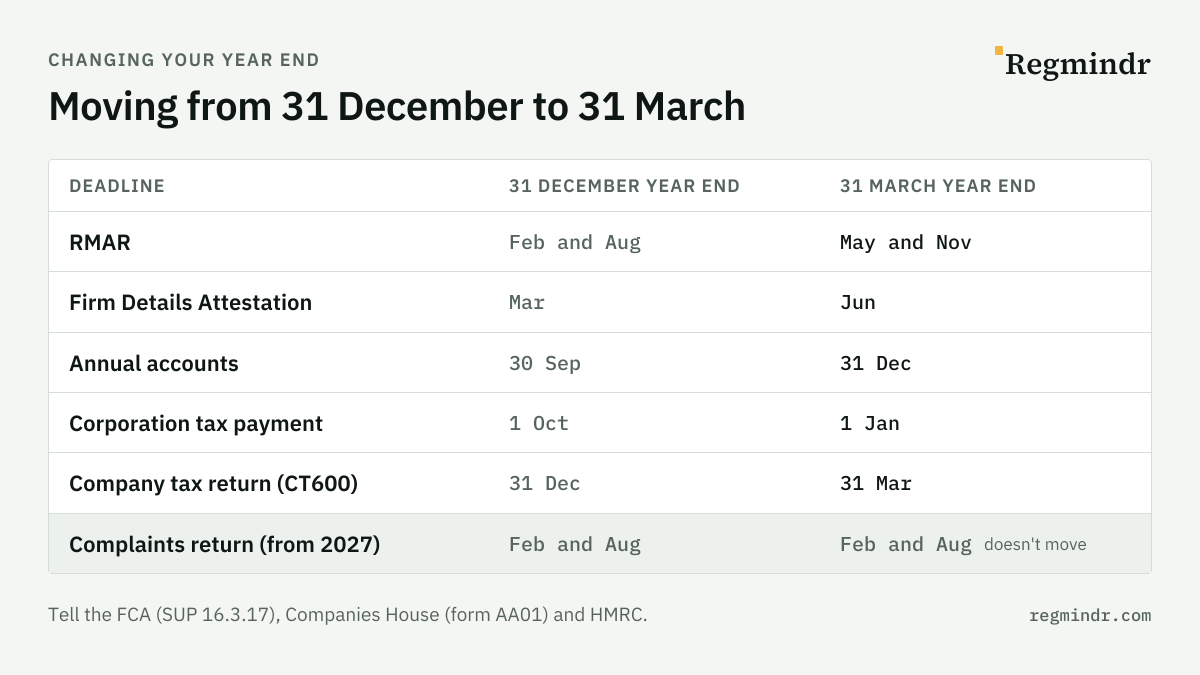
To change your year end, file form AA01 with Companies House before the filing deadline for the period you're changing, and tell the FCA and HMRC. Under SUP 16.3.17 the FCA must hear before your previous accounting reference date if you're extending the period, or before the new date if you're shortening it. Your RMAR, Firm Details Attestation, accounts and corporation tax deadlines all move with it.
- April—
- May
- RMAR30 business days after 31 Mar
- June
- Firm Details Attestation60 business days after 31 Mar
- July
- Consumer Duty board reportUsually by 31 Jul
- August
- Complaints return30 business days after 30 Jun
- FCA annual fees30 days after the invoice
- September—
- October
- November
- RMAR30 business days after 30 Sep
- December
- Annual accounts31 Dec
- January
- February
- Complaints return30 business days after 31 Dec
- March
Tell the FCA in time
SUP 16.3.17 requires you to notify the FCA when you change your accounting reference date. The deadline depends on which way you move it:
- Extending the period: before your previous accounting reference date.
- Shortening the period: before your new accounting reference date.
- Notify it through the FCA's online systems, as you would other changes to your firm details (SUP 16.10.4A).
Long periods get attention
Many FCA reporting dates are linked to your accounting reference date. The FCA's guidance in SUP 16.3.18 says that extending an accounting period to more than 15 months may hold up information it needs, and that it may act to keep receiving that information on time.
Change it at Companies House
- File form AA01 online or by post (GOV.UK). You must do it before the filing deadline for the accounts of the period you want to change, and you can't change your year end while accounts are overdue.
- Shortening: currently allowed as often as you like. From April 2028 you'll need a business reason to shorten more than once in five years (Companies House).
- When you shorten, the accounts deadline becomes the later of 9 months after the new year end or 3 months from when Companies House receives the AA01.
- Extending: to no more than 18 months from the start of the period, and only once in five years unless the company is in administration, has approval from the Secretary of State, or is aligning with a parent or subsidiary (GOV.UK).
Tell HMRC
Update your accounting period dates with HMRC too. A corporation tax accounting period can't be longer than 12 months, so if you extend your financial year beyond 12 months you file two company tax returns to cover it. Contact HMRC before the original filing date of your company tax return (GOV.UK).
Which deadlines move
- RMAR: the half-year reporting periods are set by your accounting reference date, so both returns move.
- Firm Details Attestation: due within 60 business days of the new date.
- Annual accounts, corporation tax and the CT600: counted from the new year end.
- Complaints return: from 2027 it follows fixed half-years for every firm, so it doesn't move.
- The Consumer Duty board report, FCA fees and REP008 don't depend on your year end.
Before you make the change
- Work out how your RMAR periods run across the change. The first period under the new date may be shorter or longer than six months.
- Agree the new date with your accountant, since your accounts, tax return and FCA financial data all follow it.
- Update your compliance calendar with the new date for every deadline that moves.
Get reminded before each deadline
Regmindr sets up your FCA calendar from your year end in about two minutes, and emails your team before each deadline is due.
Sources
- FCA Handbook: SUP 16.3 General provisions on reporting
- FCA Handbook: SUP 16.10 Verification of firm details
- GOV.UK: Change your company's year end
- GOV.UK: Preparing and filing Companies House accounts
- Companies House: Changes to accounts filing from April 2028
- GOV.UK: Corporation Tax accounting periods
This page is a summary, not legal or regulatory advice. The rules in the sources above take precedence.