Yes. Under DISP 1.10, a firm that received no complaints in a reporting period still submits the complaints return, marked as a nil return. It's due within 30 business days of the end of the period, and a late return costs a £100 administrative fee. From 1 January 2027 the reporting periods become fixed half-years for every firm.
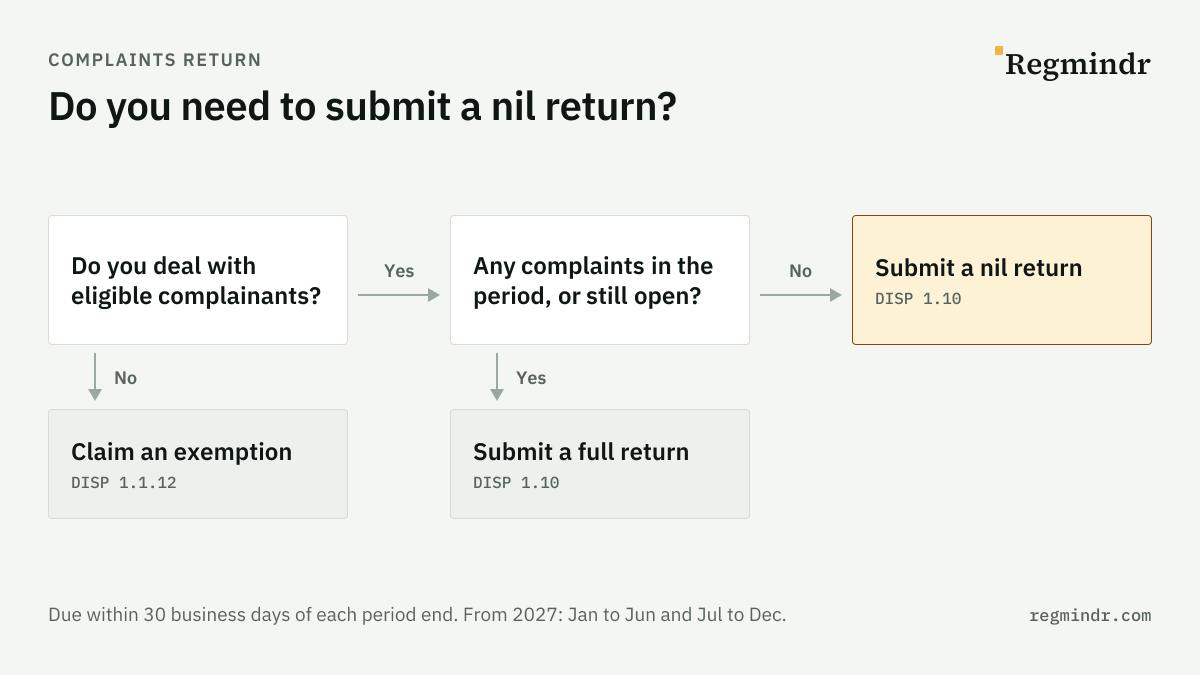
When a nil return is right
A nil return means you received no complaints during the reporting period and had none still open from earlier. From 2027 the return asks this first, and a nil return needs no further answers (DISP 1.10.1E). Before you choose it, check:
- A complaint is any oral or written expression of dissatisfaction from an eligible complainant, whether justified or not, that alleges financial loss, material distress or material inconvenience.
- Complaints you resolved by the close of the third business day still count, and are reported like any other (DISP 1.10.3).
- Complaints you forwarded in full to another firm are left out of your return (DISP 1.10.1A).
When it's due
Until the end of 2026, the reporting periods are the six months before and after your accounting reference date, and each return is due within 30 business days of the period end (DISP 1.10.4 and 1.10.5). For most firms that's the same time as the RMAR.
Every firm's current period ends on 31 December 2026, so your last return under the old rules may cover a shorter period. A firm with a 31 October year end, for example, reports 1 November to 31 December 2026. That return is due within 30 business days, in mid-February 2027.
From 1 January 2027, every firm reports on fixed half-years: 1 January to 30 June and 1 July to 31 December. Each return is due within 30 business days, so in mid-August and mid-February. Firms that currently report once a year move to twice a year as well (PS25/19).
How to file a nil return
- Submit it in RegData, the same as a full return.
- On the current return, the FCA says to "select 'No' to question 1 and 'Yes' to question 2" and leave the other fields blank, without typing "n/a" (complaints FAQs).
- On a full return, enter 0 for a product category you do business in but had no complaints about. Leave a category blank only if you don't do that business.
- From 2027 the new single complaints return offers the nil option at the start.
Who doesn't file it
Two kinds of firm don't file this return. For a typical adviser, mortgage broker or insurance broker with retail customers, neither applies, so a return is due every period.
- Firms that don't deal with eligible complainants, and are not reasonably likely to, can claim an exemption by writing to the FCA (DISP 1.1.12). Eligible complainants include consumers and some small businesses, charities and trusts (DISP 2.7).
- Firms with only a limited permission report the number of complaints in the consumer credit return (CCR007) instead (DISP 1.10.1-A).
If you miss it
A late or incomplete complaints return costs a £100 administrative fee under DISP 1.10.6A, separate from any fee for the RMAR. The fee doesn't apply if a systems failure stopped you submitting and you told the FCA in writing without delay. See what happens if you miss the RMAR deadline.
Get reminded before each deadline
Regmindr sets up your FCA calendar from your year end in about two minutes, and emails your team before each deadline is due.
Sources
- FCA Handbook: DISP 1.10 Complaints reporting rules
- FCA Handbook: DISP 1.1
- FCA Handbook: DISP 2.7 Eligible complainants
- FCA: Complaints data items FAQs
- FCA: Reporting complaints
- FCA PS25/19: Improving the complaints reporting process
This page is a summary, not legal or regulatory advice. The rules in the sources above take precedence.