Under Article 67 of MiCA (Regulation (EU) 2023/1114), a crypto-asset service provider must hold prudential safeguards of at least the higher of two amounts: the permanent minimum capital for its services in Annex IV, which is €50,000, €125,000 or €150,000, and a quarter of its fixed overheads for the preceding year. The overheads figure is reviewed every year, so the requirement grows with the business.
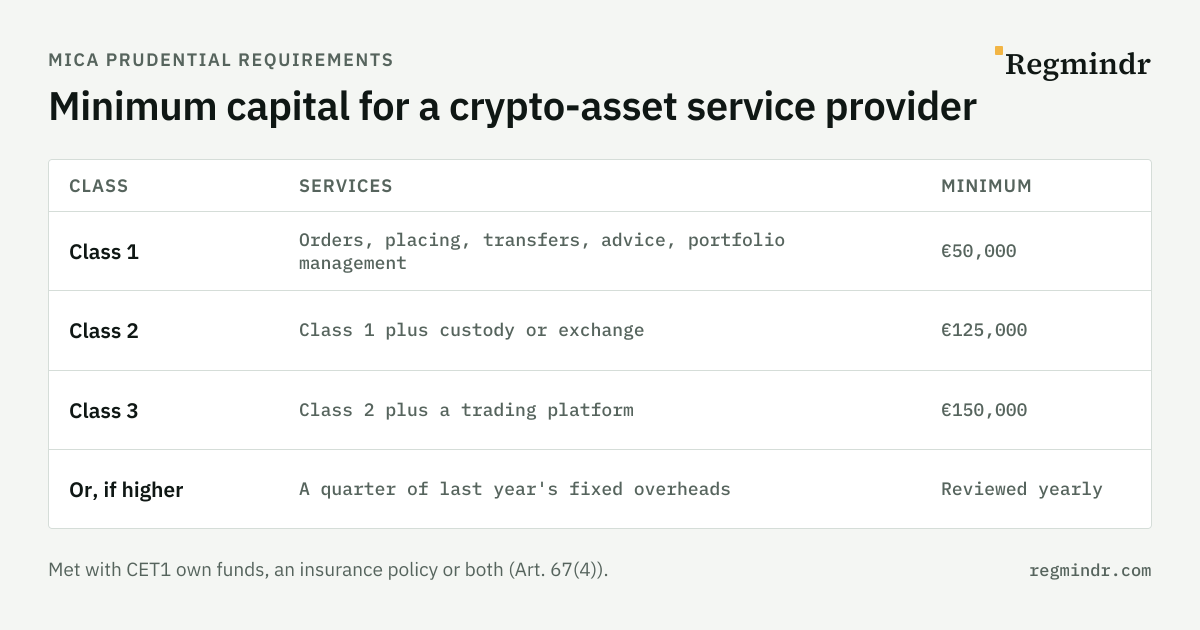
The minimum capital for each class
Annex IV sets the permanent minimum capital by the services you're authorised for:
- Class 1, €50,000: execution of orders on behalf of clients, placing of crypto-assets, transfer services, reception and transmission of orders, advice and portfolio management.
- Class 2, €125,000: any class 1 service plus custody and administration of crypto-assets for clients, or exchange of crypto-assets for funds or for other crypto-assets.
- Class 3, €150,000: any class 2 service plus operating a trading platform for crypto-assets.
The class follows your authorisation, so a firm authorised for custody is in class 2 even in a year it holds very little for clients.
The fixed overheads test
The second amount is a quarter of your fixed overheads for the preceding year, reviewed annually (Art. 67(1)(b)). Start from total expenses after distribution of profits in your most recent audited annual financial statements, and subtract (Art. 67(3)):
- Staff bonuses and other remuneration that depend on the year's net profit.
- Employees', directors' and partners' shares in profits.
- Other appropriations of profits and other variable remuneration, where they're fully discretionary.
- Non-recurring expenses from non-ordinary activities.
For example, a class 2 provider with €1.2 million of fixed overheads needs €300,000, not €125,000. Once the business is past a few hundred thousand euros of overheads a year, this test usually sets the number.
In your first year
If you haven't been providing services for a full year, use the projected fixed overheads for your first 12 months that you submitted with your application for authorisation (Art. 67(2)).
What counts towards it
The safeguards can take either form, or a combination (Art. 67(4)):
- Own funds: Common Equity Tier 1 items and instruments as defined in Regulation (EU) No 575/2013, after the full deductions and without the threshold exemptions.
- An insurance policy covering the EU territories where you provide services, or a comparable guarantee.
An insurance policy has to be disclosed on your website, run for an initial term of at least a year with at least 90 days' notice of cancellation, and come from an authorised third-party insurer (Art. 67(5)). It must cover loss of documents, misleading statements, breaches of legal, client and confidentiality obligations, conflicts of interest failures, business disruption and system failures, and, where relevant, gross negligence in safeguarding clients' assets (Art. 67(6)).
Putting it on the calendar
- Recalculate the overheads figure once a year, when your annual financial statements are audited, and top up your safeguards if it has risen.
- If you rely on insurance, track the renewal date and the 90-day notice period, so cover never lapses.
The yearly overheads review is in the MiCA compliance checklist alongside the other recurring reviews. Crypto-asset service providers are financial entities under DORA too, so see the DORA compliance calendar.
Get reminded before each deadline
Regmindr sets up your compliance calendar from a template in about two minutes, and emails your team before each deadline is due.
Sources
- Regulation (EU) 2023/1114 (MiCA), Article 67 and Annex IV
- Regulation (EU) No 575/2013 (CRR), Articles 26 to 36
This page is a summary, not legal or regulatory advice. The rules in the sources above take precedence.