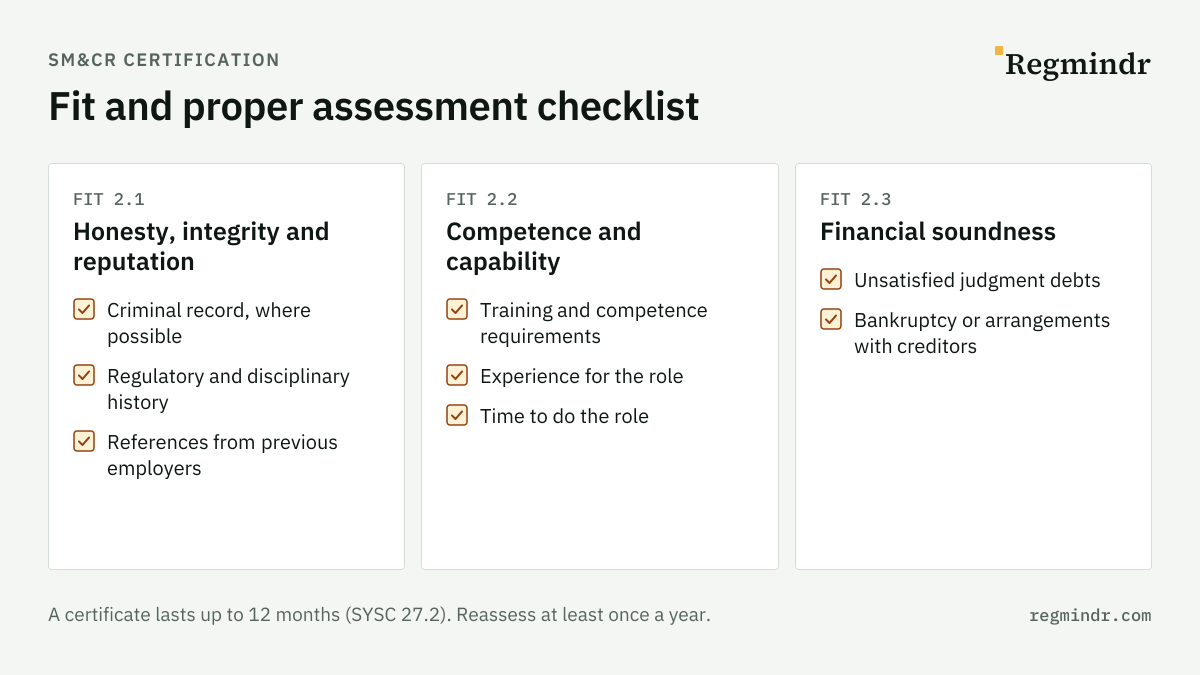
Before issuing or renewing a certificate, your firm must be satisfied that the person is fit and proper for the role. The FCA's FIT sourcebook names three main tests: honesty, integrity and reputation; competence and capability; and financial soundness. A certificate lasts at most 12 months, so each certified person is reassessed at least once a year.
Honesty, integrity and reputation
FIT 2.1 lists the matters to consider, in the UK or elsewhere. They include:
- Criminal convictions, including spent convictions where the exceptions to the Rehabilitation of Offenders Act allow. Firms should check for convictions where possible.
- Adverse findings or settlements in civil proceedings, particularly about financial business, misconduct or fraud.
- Investigations or disciplinary proceedings by the FCA, other regulators, professional bodies or government agencies.
- For new staff, what previous employers say. A firm appointing someone to a certification function asks for regulatory references under SYSC 22.
A conviction or finding doesn't automatically make someone unfit. The firm weighs how relevant and how serious it is (FIT 1.3.4).
Competence and capability
Under FIT 2.2, consider whether the person:
- Meets any training and competence requirements that apply to the role.
- Has shown through experience and training that they're suitable for it.
- Has enough time to perform the role and meet its responsibilities.
- Has been found negligent or lacking in skill by a court, disciplinary hearing or inquiry.
Assess the role the person actually does at the time. The FCA expects assessors to have an up-to-date job description (FIT 1.3.4B).
Financial soundness
Under FIT 2.3, look for judgment debts or awards that are outstanding or weren't paid within a reasonable time, and for bankruptcy, arrangements with creditors or related proceedings.
The FCA doesn't normally expect a statement of assets and liabilities, and limited financial means doesn't by itself make someone unsuitable.
Issuing the certificate
Under SYSC 27.2:
- A certificate lasts no more than 12 months from the day it's issued. You can make it shorter, but not longer.
- It states that you're satisfied the person is fit and proper, and sets out the aspects of the firm's affairs they'll be involved in.
- It must be in writing, but it doesn't need to be a physical document. An email is enough, and it should show its dates of validity.
- Keep a record of every employee with a valid certificate.
- If you decide not to certify someone, give them written notice of the steps you propose and your reasons.
Annual recertification can be lighter
Since 24 April 2026, FCA guidance says you can run certification as part of your annual appraisals, and that renewing a certificate should be proportionate and streamlined, less detailed than assessing someone new (PS26/6).
Major changes to someone's role are assessed when they happen, before they start the new function. If an adviser moves from mortgages to investments, for example, you may only need to reassess their knowledge and competence in the new area (SYSC 27.2.15A).
Keep the Directory up to date
Certified staff appear on the FCA Directory, which your firm keeps up to date. Since April 2026, firms have 20 working days instead of 7 for most Directory updates (PS26/6).
More changes may come
The Treasury is considering legislative changes to the Certification Regime, and the FCA plans wider reforms in a second phase of its review. Until the law changes, certificates still have to be renewed at least every 12 months.
Get reminded before each deadline
Regmindr sets up your FCA calendar from your year end in about two minutes, and emails your team before each deadline is due.
Sources
- FCA Handbook: FIT 1.3 Assessing fitness and propriety
- FCA Handbook: FIT 2.1 Honesty, integrity and reputation
- FCA Handbook: FIT 2.2 Competence and capability
- FCA Handbook: FIT 2.3 Financial soundness
- FCA Handbook: SYSC 27.2 Certification regime
- FCA Handbook: SYSC 22.2 Regulatory references
- FCA PS26/6: Senior Managers and Certification Regime review
- FCA: Senior Managers and Certification Regime
This page is a summary, not legal or regulatory advice. The rules in the sources above take precedence.